Sexological Bodywork: A Body-Based Revolution in Sex Education & Erotic Transformation
By Gary Albert, Clinical Hypnotherapist, Rapid Transformational Therapist and Somatic Erotic Bodyworker
Introduction: Why This Work Matters to Me
My name is Gary Albert. I am a Clinical Hypnotherapist, Rapid Transformational Therapist and Sexological Bodyworker based in Hackney, East London, where I work primarily with gay, bisexual, queer and trans men. I am trained with the School of Somatic Sexology, the UK and Ireland professional training programme directed by Kian de la Cour, which is recognised by the Association of Certified Sexological Bodyworkers (ACSB).
My path to Sexological Bodywork began with my own story. For years I lived with compulsive sexual behaviour that I now understand was rooted in disconnection from my body and my deeper erotic self. Hookups, porn use and patterns of sexual acting out were not bringing me closer to pleasure or intimacy; they were taking me further away.
The turning point came when I began to explore what I have coined as Soulful Sexuality: a conscious, embodied, present relationship with our own erotic energy through somatic sex practices, breathwork and a willingness to slow down and actually feel what was happening in our body when we are erotically activated.
Though this work I moved from compulsive, dissociative sex into something profoundly different. Sex and self-pleasure has become a source of healing, connection and creative life force rather than a numbing agent.
Before discovering Sexological Bodywork, I had been working professionally as a sensual and erotic massage practitioner for several years. I was good at it and my clients valued the work. But I increasingly felt the limitations of that model. Erotic massage, while powerful, did not have the educational framework, the ethical scaffolding or the therapeutic depth that I knew was possible.
When I encountered Sexological Bodywork through my training, everything clicked into place. Here was a modality that honoured the body, included erotic touch, operated within a rigorous code of ethics and positioned the client as the expert on their own experience.
It was the bridge I had been looking for between the somatic, hands-on work I was already doing and the therapeutic, transformational work I wanted to offer.
This article explores the history, philosophy, techniques and practice of Sexological Bodywork, drawing on my training, my client work and my own lived experience.

Sexological Bodywork is coming into the mainstream
The History of Sexological Bodywork:
Joseph Kramer and the Body Electric
Sexological Bodywork is inspired by the work of Joseph Kramer, Ph.D., a former Jesuit seminarian turned sex educator and somatic practitioner. Kramer spent ten years studying and teaching within the Jesuit order before leaving prior to ordination, but the Jesuit commitment to education and service deeply shaped his life’s work. After leaving the order, Kramer moved to Berkeley, California, completed a Master of Divinity degree and graduated from massage school.
In 1984, at the height of the AIDS epidemic, Kramer founded the Body Electric School of Massage and Rebirthing in Oakland, California. The timing was not coincidental. Gay and bisexual men’s bodies were being associated with disease, fear and death. Touch between men had become terrifying.
Kramer responded by creating safe spaces where men could experience pleasurable, conscious, erotic touch without shame or fear.
As Kramer has described, it was simultaneously the most wonderful and the most terrible time of his life, creating joy and connection in the midst of devastation and heartbreak.
In 1986, Kramer began developing and teaching Taoist Erotic Massage as a form of safe sexual connection. Because HIV was transmitted through semen, Kramer incorporated the Taoist practice of semen retention as a central element, making the massage both deeply pleasurable and safe.
The Body Electric trained men as sexual healers and erotic bodyworkers. Kramer called these practitioners “Sacred Intimates,” a term now used by thousands of practitioners worldwide.
However, Sacred Intimates and other practitioners offering Taoist Erotic Massage did not have legal professional status in the United States. To address this, Kramer approached the Institute for Advanced Study of Human Sexuality (IASHS) in San Francisco about creating a professional training. In 2003, after investigation by the California Bureau of Private Postsecondary Education, Sexological Bodywork was approved as a legal profession in California.
This was a landmark and groundbreaking moment as it was the first state-approved somatic sex education certification in the United States.
Since then, Sexological Bodywork training programmes have been established internationally, with recognised schools in the United States, the United Kingdom, Ireland, Germany, Canada, Australia and Brazil.
The Association of Certified Sexological Bodyworkers (ACSB), founded in 2005, maintains a code of ethics, a grievance process and a practitioner directory.
In the UK, the School of Somatic Sexology (where I trained) and the Relational Harmony Institute both offer ACSB-recognised certification programmes.
In the UK, the current standard-bearer for Sexological Bodywork training is Kian de la Cour, founder and director of the School of Somatic Sexology. Kian first encountered the modalities taught in Sexological Bodywork in 1994 when he trained as a Sacred Intimate with the Body Electric School at Wildwood, California, learning Taoist Erotic Massage, anal massage and breathwork.
He qualified as a Certified Sexological Bodyworker in 2014, gained his CSSE (Certificate in Somatic Sex Education) in 2015, and has since directed over a dozen UK and Ireland training cohorts, certifying more than 250 practitioners.
Kian co-founded the Sea School of Embodiment with Katie Sarra in 2014, hosting the first CSB and CSSE trainings to take place in the UK, before establishing the School of Somatic Sexology as a standalone training programme. He is President of the ACSB, co-founder and Chair of the Association of Somatic and Integrative Sexologists (ASIS), and a Certified Wheel of Consent Workshop Facilitator. His faculty includes Joseph Kramer himself, Betty Martin and Ellen Heed.
The School's comprehensive 620+ hour programme is the only certified Sexological Bodywork training wholly based in the UK and Ireland. I want to honour Kian here because his dedication to bringing this work to the UK, his rigour in maintaining international ethical standards and his personal generosity as a teacher have made it possible for practitioners like me to train in this modality without leaving the country. His vision for the profession is both grounded and expansive, and the quality of the training reflects decades of his own embodied practice and learning.
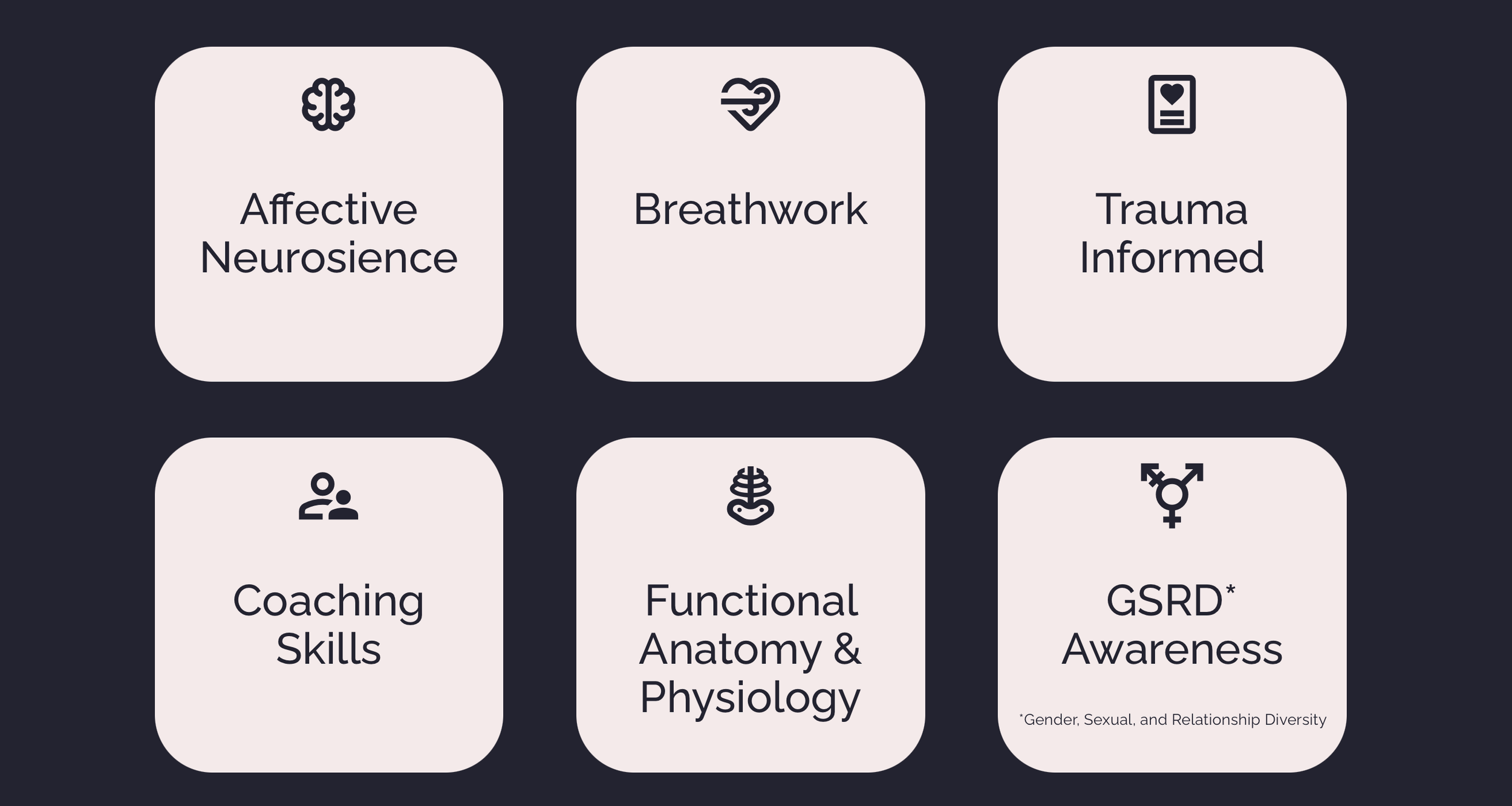
Some of the skills learned in Sexological Bodywork
The Philosophical Foundation:
The Client as Expert
At the heart of Sexological Bodywork is a radical philosophical position that believes that the client is the expert on their own problem. This is not a modality where the practitioner diagnoses, interprets or prescribes anything.
The practitioner’s role is to hold the space, create safety and guide the client towards their own somatic breakthrough. The primary vehicle for that breakthrough is the somatic bodywork itself and the direct, felt experience in the body and the insights that come with it.
This principle draws from several traditions. Eugene Gendlin’s Focusing, developed through research at the University of Chicago in the 1960s, demonstrated that the clients who made the most progress in therapy were those who could turn their attention inward and sense into a bodily felt “something” that had not yet been put into words. Gendlin called this the “felt sense.”
His research showed that therapeutic success depended not on the therapist’s technique or theoretical orientation, but on the client’s ability to access this inner bodily knowing.
Sexological Bodywork takes this insight and builds an entire practice around it by working directly with the body, we help clients access felt senses that talk therapy alone may find difficult to reach.
Although in my work, personally, I have noticed that clients that have done some form of talk therapy, counselling or psychotherapy tend to lean into this work faster and more effectively.
David Grove’s Clean Language complements this approach. Clean Language is a method of questioning that uses the client’s own words, metaphors and images rather than introducing the practitioner’s interpretations.
In Sexological Bodywork, Clean Language helps the practitioner stay out of the client’s process and avoid leading them towards predetermined outcomes.
Questions like “And what kind of heaviness is that heaviness?” or “And is there anything else about that heaviness?” keep the client’s attention on their own embodied experience. The practitioner mirrors back the client’s language without adding meaning, allowing the client’s inner wisdom to unfold on its own terms. This has proven to be profound in my work with clients. The breakthroughs are often phenomenal.
These two threads, Focusing and Clean Language, weave together beautifully in practice. The client is guided to notice what is alive in their body (Focusing), and the practitioner uses the client’s own words to support that noticing without interpretation (Clean Language). Combined with the somatic bodywork techniques, this creates a powerful container where the client genuinely leads their own learning.
The Techniques: A Woven Practice
Sexological Bodywork draws on a range of techniques that weave together to create a holistic, body-based practice. While each technique can be described separately, in a session they flow into and inform each other organically always guided by the client, and the educational contract we create together for their learning.
The Wheel of Consent, developed by Dr Betty Martin, is the foundational framework that underpins how touch and communication work in every Sexological Bodywork session. Martin is a chiropractor, Certified Sexological Bodyworker and Body Electric School trained Sacred Intimate with over thirty years of hands-on professional experience.
Her Wheel of Consent maps four distinct dynamics of touch: Serving, Taking, Allowing and Accepting. Each quadrant clarifies who the touch is for and who is doing it, making explicit something that is usually unconscious in intimate encounters.
In Sexological Bodywork, the Wheel of Consent gives both practitioner and client a shared language for navigating touch with clarity and safety. It teaches clients that knowing what you want, and being able to ask for it, is more important than any specific technique.
The choosing is more important than the doing. For many clients, this is revelatory: they have never been asked what they actually want, or given a framework for understanding why certain kinds of touch feel nourishing and others feel draining.
The Wheel of Consent is taught on every ACSB-recognised Sexological Bodywork training worldwide, and Martin's work has influenced the entire field of somatic sex education. In my own practice, it forms the basis of every session I run, shaping how consent is invited, how I frame touch and how I support clients in developing their own agency and voice in erotic experience. Added to that it has changed my own sex life and sexual encounters with partners and lovers.
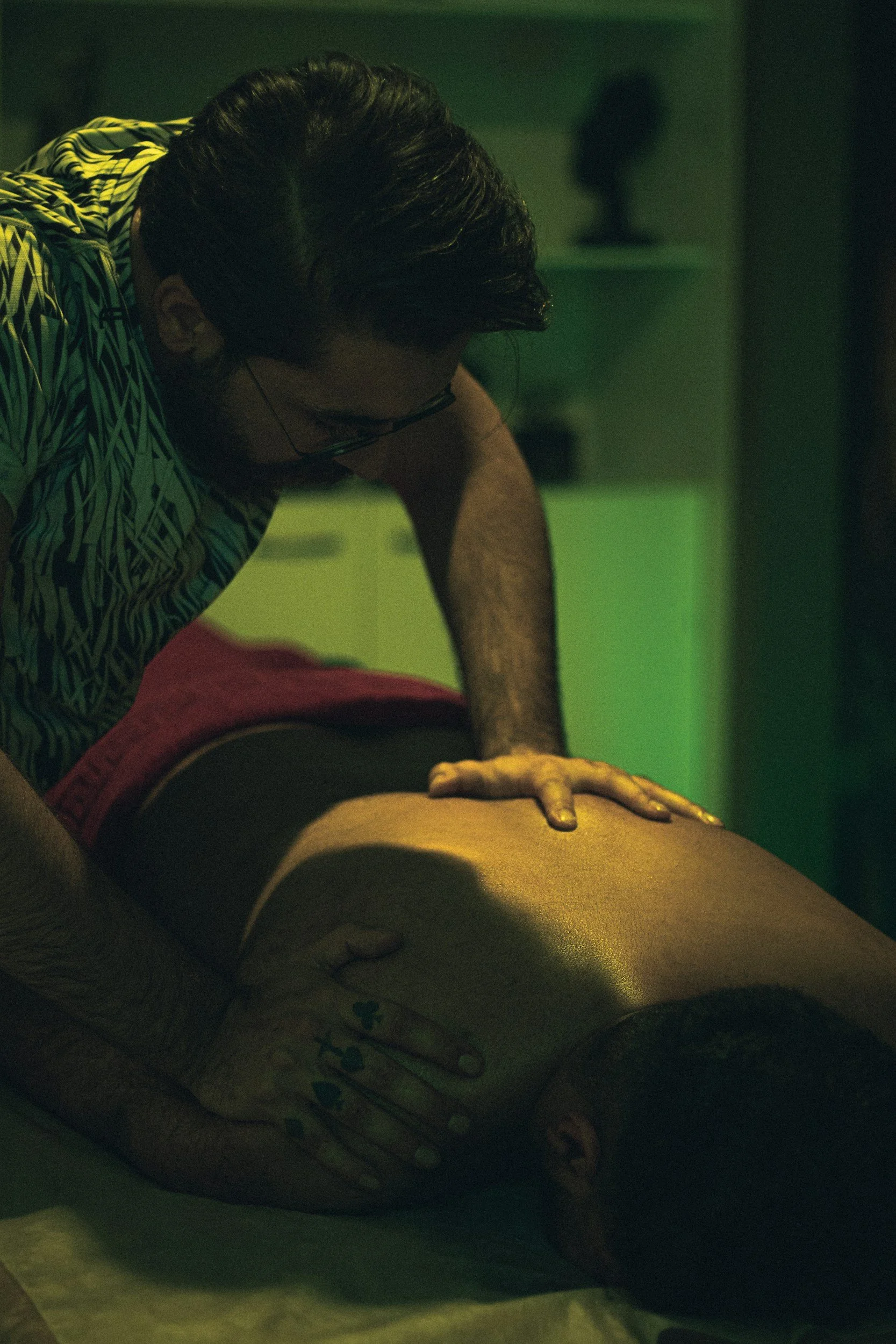
Taoist Erotic Massage is one tool in Sexological Bodywork
Taoist Erotic Massage
One of the foundational practices, developed by Joseph Kramer in 1986. It combines conscious, erotic touch with breathwork, sound and movement.
The recipient learns to circulate arousal through their whole body rather than concentrating it in the genitals alone. Semen retention (for those with penises) is practised, allowing arousal to build and be experienced as whole-body energy rather than a rush towards ejaculation. In my work with gay men, this technique has been transformative for clients dealing with premature ejaculation, compulsive sexual patterns, erectile dysfunction and a limited range of erotic experience.
Through Taoist Erotic Massage, clients discover that arousal can be a sustained, expansive, full-body experience rather than a brief, localised event.
Active Receiving
Teaches the client to receive touch with full presence and attention. Rather than passively lying there as in the traditional massage I was more accustomed to, the client actively engages with what they are feeling, using breath, sound and movement to stay present with sensation. This technique is particularly powerful for people who have learned to dissociate during sexual experiences, or who habitually focus on their partner’s pleasure rather than their own, and those who find it difficult to receive
Body Poem
Created by Katie Sarra, Certified Somatic Sex Educator, Art Psychotherapist and co-founder of the Sea School of Embodiment.
Body Poem is a skilled synthesis of Focusing (Eugene Gendlin), Clean Language (David Grove) and a Playback Theatre technique called Dream Form. Through a guided meditative process, the client is invited to notice what sensations are alive in their body, as swell as their wishes, wants and desires. These emerging sensations are brought into expression, and the intimate revelations shared form the basis of a spontaneous poem.
The structure of Body Poem draws on Jaak Panksepp’s research on emotional command systems, Daniel Siegel’s work on interpersonal neurobiology, Betty Martin’s Wheel of Consent and Stephen Porges’ Polyvagal Theory. In practice, Body Poem creates a way of witnessing and giving language to what the body is communicating, often revealing hidden drivers and patterns that the conscious mind has not yet articulated. I use Body Poem at the beginning of every session to help clients connect with what their body actually wants, which is often very different from what their mind thinks they want. Coupled with somatic touch, this is profoundly revealing, often emotional and also, I might add, super fun!
Breathwork
Woven throughout the entire practice. Breath is the primary tool for managing arousal, staying present with sensation and moving energy through the body. In Sexological Bodywork, clients learn to breathe deeply into their belly and pelvis, to use sound (moaning, growling, sighing) as an amplifier of sensation, and to use movement (rocking the pelvis, undulating the spine) to circulate arousal. These three elements, breath, sound and movement, form a trinity that underpins every technique in the practice. For many clients, simply learning to breathe and make sound during erotic experience creates a dramatic shift. Most people hold their breath and clench their bodies during sex, which restricts sensation and accelerates ejaculation. Learning to breathe and open the body changes everything. Techniques are inspired by tantra and taoist tradition as well as contemporary breath work practices.
Focusing and Clean Language,
As discussed earlier, this inform how the practitioner holds the space. They are not separate techniques applied at specific moments, but rather a way of being with the client that permeates the entire session. The practitioner listens to the client’s body as much as to their words, notices emerging sensations, and uses the client’s own language to reflect experience back without interpretation.
Learn more about Focussing and Clean Language
How Sexological Bodywork Differs from Traditional Talk Therapy & Other Things
It is important to say that Sexological Bodywork is not a replacement for psychotherapy, counselling or other established therapeutic modalities. It occupies a different space and does different work.
Many clients benefit enormously from combining Sexological Bodywork with talk therapy, and the ACSB Code of Ethics encourages practitioners to support clients in sharing their sessions with other care providers on their care teams where appropriate.
That said, there are meaningful differences worth exploring. In traditional talk therapy, the therapist and client typically sit across from each other. The work happens through language: words, narrative, interpretation, cognitive reframing. The body may be referenced, but it is rarely directly engaged, unless the therapist is also trained in a somatic approach.
The therapist may observe body language, but does not typically touch the client. This model has enormous value and has helped millions of people, including myself. Cognitive and narrative approaches can create lasting change in how people understand and relate to their experiences.
Sexological Bodywork works differently. The practitioner uses direct, one-way touch, which means touch flows from practitioner to client only. The client does not touch the practitioner. This one-way framework creates a unique opportunity: the client can focus entirely on the sensations in their own body without any pressure to perform, reciprocate or attend to a partner’s experience. For many people, this is the first time they have ever received erotic or intimate touch with absolutely no expectation attached. The practitioner remains clothed and uses gloves for genital touch, maintaining clear professional boundaries.
The inclusion of touch, including erotic touch, is perhaps the most significant distinction. Many sexual difficulties live in the body: premature ejaculation, difficulty with arousal, pain during sex, numbness, dissociation, habitual tension patterns.
These are not problems that can always be resolved through conversation alone. By working directly with the body, Sexological Bodywork can access and shift patterns that are held somatically. A client can talk about premature ejaculation for months in therapy, but learning to use the arousal scale, breathwork and conscious touch while actually being touched erotically provides a direct, embodied experience of something different. That somatic experience often creates change in ways that insight alone cannot.
This is not a criticism of talk therapy. It is simply an observation that different modalities access different layers of experience. Sexological Bodywork fills a gap in the professional landscape where body-based, touch-inclusive sexual education and healing was previously unavailable within an ethical, boundaried framework.

Sexological Bodywork differs from talk therapy
The Code of Ethics: Safety, Consent and Professional Boundaries
The ethical framework of Sexological Bodywork is rigorous and evolving. The ACSB Code of Ethics, first developed in the early years of the profession and most recently revised in April 2024, sets out clear standards for practitioner conduct. Several key principles are worth highlighting.
The practitioner’s primary ethical responsibility is to the client’s wellbeing. The practitioner works to establish a relationship the client experiences as safe, consensual and fully engaged. The practitioner commits to reducing harm that could follow from self-serving gratifications such as authority, power, sexual pleasure or admiration. This is directly relevant to my own practice: when working with clients, I must continually monitor my own body and motivations, noticing any impulses that serve my needs rather than the client’s learning. This has been challenging coming from an erotic and sensual massage background where my own arousal was often part of the work itself.
Consent in Sexological Bodywork is understood as an ongoing negotiation rather than a one-time permission. The 2024 revision of the ACSB Code specifically moved away from the “gatekeeper model” of consent (where consent is obtained once) towards a model of continuous, negotiated consent throughout a session. In practice, this means regular verbal check-ins, clear agreements about what will happen and an understanding that the session can include less than was originally intended but cannot be expanded once begun (this is called an educational contract).
The one-way touch framework is both an ethical safeguard and a therapeutic tool. Because the client does not touch the practitioner, the dynamic remains educational rather than sexual. The practitioner operates outside of their own arousal, in service of the client’s learning. This requires ongoing self-awareness and supervision.
Practitioners are expected to engage in continuing professional development and regular supervision as routine parts of their practice. The ACSB also maintains a grievance process for addressing ethical concerns, and practitioners commit to contacting colleagues directly and respectfully when ethical concerns arise.
Client Stories: How This Work Creates Change
To illustrate how these techniques come together in practice, I want to share some examples from my client work (using initials only, in accordance with confidentiality requirements). These stories are shared with permission.
One client, OPL, came to me with premature ejaculation. He wanted to be able to receive erotic touch without ejaculating too quickly. We began with a Body Poem to connect him with what he actually wanted from the session in his body, not his head.
We then moved through Bossy Massage pioneered by ‘The Wheel of Consent’ creator Betty Martin, (where he practised directing my touch), genital mapping (bringing awareness and language to different areas of sensation) and into Taoist Erotic Massage combined with Active Receiving. I coached him to use the arousal scale, naming his arousal level and using breath, sound and movement to manage it. We worked with this for an extended period and he was able to stay present with erotic touch without ejaculating. He described the session as a profound experience and particularly valued the blend of psychological and physical work.
Another client, DJM, had developed a pattern of needing increasingly extreme pain and choking during sex to feel aroused. He had passed out during choke play, which frightened him and prompted him to seek help.
His intention was to discover whether gentle, sensual touch could feel as intense as pain. We used Body Poem, coached self touch, bossy massage, genital mapping, anal massage and Taoist Erotic Massage.
The session focused entirely on gentle, slow touch. The anal massage proved particularly powerful, offering deep, intense arousal that was completely gentle and safe. He experienced sustained arousal through softness alone and reported that the intensity rivalled or exceeded what he had experienced through pain play. Tears came during the session as something released. He said he had been given permission to want something softer.
In my own journey, the practices of Sexological Bodywork transformed my relationship with my body and my sexuality. Through committed self-pleasure practice using Taoist Erotic Masturbation techniques, I moved from compulsive, habitual masturbation into a conscious practice that became a source of creative energy, physical power and deep pleasure.
This personal experience is not incidental to my practice, it is foundational. In Sexological Bodywork, the practitioner’s own embodied practice is considered essential. You cannot guide someone to a place you have not been yourself.
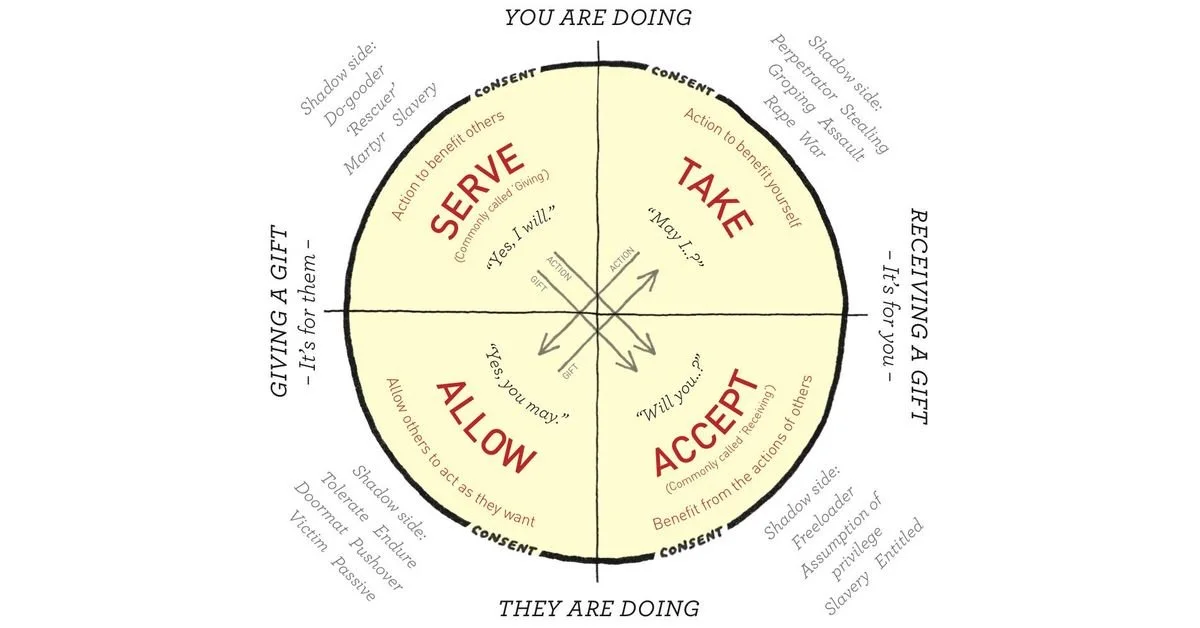
Wheel of Consent by Dr Betty Martin
Limitations and the Broader Landscape
Sexological Bodywork is not a panacea. It is not a substitute for medical treatment, psychiatric care or psychotherapy. It does not claim to cure sexual dysfunction or treat mental health conditions. It is an educational modality, framed within a learning and coaching model rather than a clinical or therapeutic one.
There are also practical limitations. The legal status of hands-on erotic education varies by jurisdiction. The work requires a high degree of self-awareness, ethical maturity and ongoing supervision from the practitioner. The intimate nature of the work means that practitioners must continually monitor their own arousal, motivations and boundaries. This is challenging, ongoing work that requires humility, honesty and a genuine commitment to the client’s wellbeing above all else.
Peer-reviewed research specifically examining Sexological Bodywork outcomes remains limited, though growing. A mixed-methods study published in Sexual and Relationship Therapy examined outcomes of a Sexological Bodywork retreat for women, and a 2025 abstract in The Journal of Sexual Medicine described SB as a complementary method to sex therapy for transgender and gender-diverse clients. As the profession matures, more research will strengthen the evidence base and help integrate Sexological Bodywork into the broader landscape of sexual health care.
Conclusion: A Practice of Embodied Learning
Sexological Bodywork represents something genuinely new in the professional landscape: a boundaried, ethical, body-based practice that works directly with erotic touch and arousal in service of education and healing.
Its roots in Joseph Kramer’s visionary response to the AIDS crisis, its integration of ancient practices like Taoist Erotic Massage with contemporary somatic approaches like Focusing and Clean Language, and its unwavering commitment to the client as the expert on their own experience make it a powerful and unique modality.
For me personally, this work is the culmination of everything I have learned and lived. From my own journey through compulsive sexual behaviour to the discovery of soul sexuality, from my years as an erotic massage practitioner to the rigour and depth of Sexological Bodywork training, every step has led here. I am passionate about bringing this work to gay, bisexual, queer and trans men in London and beyond, because I know from my own body what is possible when we stop performing sex and start actually feeling it.
The body knows. Our role as Sexological Bodyworkers is to help people listen.
Gary Albert is a Clinical Hypnotherapist. Rapid Transformational Therapist and Sexological Bodyworker in training based in Hackney, East London. He is training with the School of Somatic Sexology (UK and Ireland), directed by Kian de la Cour. He works primarily with gay, bisexual, queer and trans men through his therapy practice, his community workshop Pleasure Medicine, and his writing on Evolution For Men (Substack).